30 Day Preventive Maintenance Scheduling Pilot for Field Managers
Run a field-first preventive maintenance scheduling pilot in 30 days. Manager-ready checklist, 30, 60, 90 examples, CMMS tips, and parts strategy to...

30 Day Preventive Maintenance Scheduling Pilot for Field Managers

A preventive maintenance schedule assigns recurring inspection and service tasks to equipment before failure happens, cutting downtime, extending asset life, and making repair costs predictable instead of chaotic. The first move is simple: pick one high-impact asset, like your busiest service van or your largest rooftop unit, and schedule its next recurring task today.
TL;DR:
- Most shops should prioritize scheduling simple, high-impact assets, like service vans or rooftop units, to improve reliability and reduce unplanned work.
- Blending fixed, meter-based, and condition-triggered intervals can optimize maintenance for different equipment types, especially when supported by failure data.
- Building an effective schedule requires thorough asset inventory, prioritization by criticality, and pilot testing before full deployment to prevent operational disruption.
- Mobile, offline-capable CMMS tools that automate recurring work orders and attach parts improve technician compliance and response time.
- Tracking key metrics such as planned versus unplanned work and schedule compliance helps ensure the maintenance program effectively reduces downtime and emergency repairs.
Table of Contents
- What a preventive maintenance schedule is and why it matters
- Types of PM schedules and how to choose between them
- Step-by-step: build and roll out a preventive maintenance schedule
- How to set intervals and triggers (including 30-60-90 examples)
- Operationalizing the schedule: CMMS, mobile workflows, and data collection
- KPIs and measurement: how to know the schedule is working
- Practitioner perspective: founder lessons and common pitfalls
- What managers get wrong about preventive maintenance
- MEPflow: field-first scheduling to run your PM program
- Authoritative resources to check
- Sources
- FAQ
What a preventive maintenance schedule is and why it matters
A preventive maintenance schedule assigns recurring, time or usage-based tasks (oil changes, filter swaps, belt inspections) to equipment before something breaks, in contrast to reactive maintenance, which only responds after a failure, and predictive maintenance, which uses condition data to trigger work. NIST maintenance guidance frames preventive maintenance as schedule-driven and predictive maintenance as data-triggered, and recommends blending both to cut unnecessary downtime while keeping costs under control.
For a 2 to 30 truck plumbing, HVAC or electrical shop, the operational payoff shows up in a few concrete ways:
- Fewer breakdowns mid-job, since routine checks catch worn parts before they fail on a customer’s property.
- Longer equipment life, because consistent service protects the investment in trucks, compressors, and tools.
- Predictable costs, since planned parts and labor are cheaper than emergency repairs and rush orders.
Prioritize building a schedule now if you’re losing billable hours to unplanned truck repairs or callbacks on installed equipment.
Types of PM schedules and how to choose between them
Not every asset needs the same scheduling logic. Matching the type to the equipment is what separates a working program from a paperwork exercise.
- Fixed or time-based: service triggered by a calendar interval, like monthly generator checks, best for assets with steady, predictable wear.
- Floating: the next task is scheduled a set interval after the last one completes, useful when job backlogs make fixed calendar dates unrealistic.
- Meter or usage-based: triggered by hours, cycles, or mileage, a natural fit for fleet vehicles and rotating machinery like pumps and compressors.
- Condition-based or predictive: triggered by measured wear, vibration, or performance data, suited to high-value or hard-to-predict equipment.
- Risk-based: intervals set by the cost and safety consequence of failure, not just by age or usage.
HVAC rooftop units often do best on a blend of fixed and meter-based intervals, while service trucks lean on mileage. Rotating equipment in commercial jobs benefits from condition monitoring once the budget allows for it. RCM and later reliability analysis found that many items don’t fail more often simply because they’re older, which is why hard time-based replacement isn’t always the most cost-effective choice. Blending types, and reviewing which tasks actually prevent failures, is closer to how reliability-centered maintenance programs operate in practice.
Step-by-step: build and roll out a preventive maintenance schedule
Building a schedule that survives contact with a busy dispatch board takes a sequence, not a spreadsheet dump, so consider how to Garagetool.
- Inventory every asset: capture make, model, serial number, install date, location, and current condition for trucks, tools, and installed customer equipment you service under contract.
- Prioritize by criticality: rank assets by cost of downtime and safety consequence; a dispatch van that misses three jobs a week outranks a rarely used ladder rack.
- Translate manufacturer guidance into tasks: pull recommended service intervals from equipment manuals and convert them into specific checklist items.
- Set intervals and triggers: decide which assets run on calendar time, mileage, hours, or condition data, as covered in the next section.
- Create recurring work orders: build each task as a repeating job so it reappears automatically instead of relying on someone’s memory.
- Assign technicians and parts: attach the right tech and a parts list to each recurring order so nothing stalls waiting on a supply run.
- Pilot before scaling: run the new schedule on one truck or one equipment class for 30 days, then expand once the kinks are worked out.
A basic inventory template needs only a handful of fields to start: asset ID, location, service interval, last service date, and assigned technician. Add fields for parts needed and estimated labor time once the pilot proves out.
Pro Tip: Start your pilot with the asset that causes the most scheduling pain today, not the one that’s easiest to document.
Spare parts strategy matters as much as the schedule itself. Stock consumables tied to your highest-frequency tasks (filters, belts, fluids) on the truck itself, and keep a reorder trigger tied to usage rather than a fixed calendar date so a fast month doesn’t catch you short.
How to set intervals and triggers (including 30-60-90 examples)
Interval selection starts with the manufacturer’s recommendation, then gets adjusted with your own operating data. OSHA’s guidance on RAGAGEP requires that inspection and test frequency follow manufacturer recommendations or recognized good engineering practice, and that employers document which standard they chose and why, a habit worth adopting even outside regulated process equipment.
- Time-based triggers work for assets with steady wear patterns regardless of use, like seasonal HVAC filter changes.
- Meter-based triggers (mileage, run-hours, cycles) fit fleet vehicles and equipment with variable usage.
- Condition-based triggers rely on measured signals, vibration, temperature, and pressure, and suit higher-value or harder-to-predict assets.
- Age-exploration: track failure data over time and adjust intervals when the data shows a task isn’t catching problems early enough, or is running more often than needed.
A common pattern for fleet vehicles schedules progressively deeper service at three intervals growing approximately every 30,000 miles, with tasks growing more thorough at each stage. Rotating equipment can follow a similar logic: light inspection at 30 days, fluid and filter checks at 60 days, full teardown inspection at 90 days, then adjusted based on what each cycle turns up.
Operationalizing the schedule: CMMS, mobile workflows, and data collection
A schedule only works if the field can actually execute it from a truck. The tools matter less for their feature count than for how much friction they remove from a tech’s day.
- Recurring work orders that generate automatically, so no one has to remember to create next month’s task.
- Mobile access that works offline, since a basement mechanical room or rural job site often has no signal.
- Photo and signature capture, giving proof of completed work for warranty claims and compliance records.
- Parts lookup tied to the work order, so a tech knows what to grab before leaving the shop.
Industry reporting on fleet readiness notes that offline mobile access, simple checklists, photo evidence, and parts lookups are commonly the features that determine whether small fleets and contractor crews actually adopt a maintenance tool. Tie the schedule into your parts purchasing and accounting systems where possible, so a completed PM task updates inventory and job costing without double entry.
KPIs and measurement: how to know the schedule is working
Tracking the right numbers tells you whether the schedule is preventing failures or just generating paperwork.
- Percent planned versus unplanned work, the clearest single signal of whether PM is replacing emergency repairs.
- Mean time between failures (MTBF) and mean time to repair (MTTR), tracked per asset class.
- Equipment availability, the share of time an asset is actually ready for work.
- PM backlog and schedule compliance, how many tasks are overdue versus completed on time.
NIST’s maintenance research frames a mix of preventive and predictive maintenance as the path to lower downtime without runaway cost. Pull these metrics directly from completed work orders and technician logs, and review them monthly for the first quarter, then quarterly once the program stabilizes. A rising backlog or falling schedule compliance is the earliest sign a schedule needs fewer tasks, better intervals, or more field hours assigned to it.
Practitioner perspective: founder lessons and common pitfalls
The barriers to a working PM program are rarely about the schedule logic itself. They’re parts not on the truck when needed, approvals that stall a work order for days, technicians too rushed to fill out a checklist, and data that lives in someone’s head instead of a system. Field-focused tools that keep checklists short and attach parts directly to the task tend to see far better completion rates than paper logs or generic spreadsheets, simply because they fit how a tech already works between jobs.

What managers get wrong about preventive maintenance
The biggest mistake isn’t choosing the wrong interval, it’s assuming that writing the schedule is the hard part. The hard part is sustaining it once the backlog gets busy and a tech skips a checklist to make the next job on time. Reliability-centered maintenance research backs this up: a schedule built on manufacturer defaults and never revisited drifts out of sync with how equipment actually fails. The conventional advice to “build a comprehensive PM program” before doing anything else is backwards for a small shop. Start with one asset class, prove the task catches real problems, then expand. Managers also overrate condition-based monitoring for every asset. It earns its upfront cost on high-value, unpredictable equipment, but a fixed calendar check is often enough for a simple pump or a seasonal filter. Prioritize the discipline to review and adjust intervals using your own failure data over chasing a more complex scheduling model.
— Jonathan
MEPflow: field-first scheduling to run your PM program
Running a PM schedule on paper or in a spreadsheet works until the shop grows past a handful of trucks, which is where field service software like MEPflow fits for owners and office managers of small to mid-sized plumbing, HVAC and electrical shops.
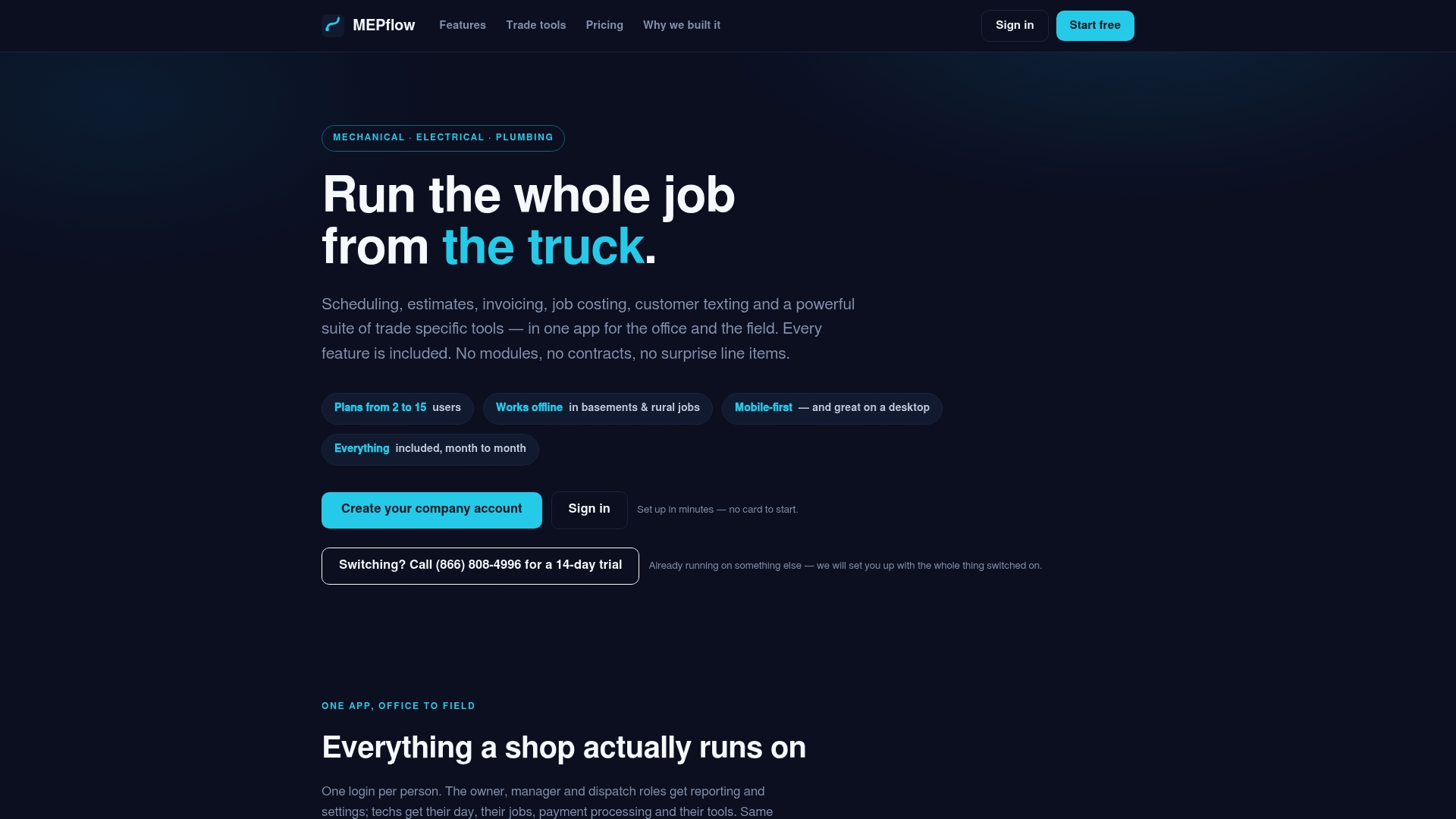
This software builds the PM schedule into the same app your techs already use for jobs, estimates, and invoicing:
- Recurring work orders that regenerate automatically so no PM task gets missed between dispatch calls.
- Mobile access that works offline, syncing photos, parts, and job status once signal returns.
- Trade calculators and a per-trade pricebook reachable from the job itself, not a separate app.
- Job costing tied to every completed task, so PM work rolls into the numbers you already track.
The platform was built by experienced tradespeople who use it themselves. Create your company account to try it on your schedule, or check plan details at /#pricing. If you’d rather talk it through first, call 866-808-4996 to book a 14-day trial.
Authoritative resources to check
A few primary documents cover most of what managers need when setting up intervals and defending them during an audit.
- The NASA RCM guide explains reliability-centered maintenance theory and why age-based replacement often underperforms condition-based tasks.
- OSHA’s RAGAGEP interpretation sets regulatory expectations for inspection frequency and documentation on process equipment.
- NIST’s maintenance guidance lays out baseline definitions for preventive and predictive maintenance and how to balance the two.
- Manufacturer manuals remain the first stop for a starting interval on any specific piece of equipment.
Sources
- RCM Guide (NASA)
- RAGAGEP in Process Safety Management Enforcement | OSHA
- NIST maintenance guidance
- Every job starts with a vehicle that shows up | Contractor Magazine
FAQ
What is a preventive maintenance schedule?
A preventive maintenance schedule is a recurring plan of inspection and service tasks performed on a set calendar, usage, or condition trigger, done before a failure occurs rather than after. It’s built from manufacturer recommendations, then adjusted using your own equipment’s failure history.
What is the 30-60-90 maintenance schedule?
The 30-60-90 pattern schedules progressively deeper service at three intervals, commonly used for vehicle fleets with a basic inspection around 30,000 miles, and inspections and fluid or filter service at about every 30,000-mile step. The same logic applies to rotating equipment using days instead of mileage, with tasks growing more thorough at each stage.
What are the 5 types of preventive maintenance?
The common categories are fixed or time-based, floating, meter or usage-based, condition-based or predictive, and risk-based scheduling. Most shops blend several types across their asset mix rather than relying on just one.
How are PM checks scheduled in practice?
PM checks are scheduled through recurring work orders tied to a calendar date, a meter reading like mileage or run-hours, or a measured condition trigger such as vibration or temperature. A field-ready mobile system can generate these work orders automatically and route them to the right technician without manual rescheduling each cycle.
How do I choose maintenance intervals for new equipment?
Start with the manufacturer’s recommended interval, since that reflects the design life and warranty terms for the equipment. Adjust from there using your own run-hours or failure data once you have a few service cycles of history, following the same logic OSHA’s RAGAGEP standard expects for documented inspection frequency.
Where to next
- See what MEPflow doesScheduling, estimates, dispatch, invoicing and job costing in one app.
- Create your company accountSet your shop up in a few minutes. No card to start.
- How to Reduce Field Service Scheduling TimeMore from the MEPflow blog
- Cut No Shows 25%: Text Appointment Reminders for Service ShopsMore from the MEPflow blog