Simple Job Costing Software for Plumbers
Learn how simple job costing software helps plumbers track labor and materials by job, improve profitability, and invoice before leaving the site.
Table of Contents
- Why Plumbers Need Simple Job Costing Software
- Best Job Costing Software for Small Plumbing Businesses
- Plumbing Estimating and Job Costing Software: Core Features That Matter
- Plumbing Labor and Material Cost Tracking: Reconciling Estimates to Actuals
- Building a Plumbing Job Costing Template That Works
- How Job Costing Improves Profitability and Cash Flow
- Implementing Job Costing: From Field to Invoice
- Conclusion
- Frequently Asked Questions
Last Updated: October 7, 2026
Why Plumbers Need Simple Job Costing Software
Plumbers operate on thin margins. A job that looked profitable on paper often reveals hidden costs once the invoice goes out. Labor runs longer than estimated. Materials cost more than quoted. Overhead gets buried in the noise.
The real problem isn't that plumbers don't track costs. It's that they track them in fragments. One notebook for labor hours. Another spreadsheet for materials. A third system for invoices. By the time the data gets reconciled, the job is done and the profit margin is already set in stone.
This is where simple job costing software for plumbers changes the equation. It pulls together estimates, actual labor time, material usage, and overhead into one view. You see what you quoted versus what you actually spent. You spot the jobs that bleed money before they happen again. Most importantly, you invoice before leaving the site, capturing payment while you're still top of mind.
At MEPflow, we built job costing specifically for field teams. No spreadsheets. No manual data entry from the field. Just a mobile app that tracks costs as work happens, then reconciles estimates to actuals so you know exactly where your profit went.
Best Job Costing Software for Small Plumbing Businesses
For shops with 2-10 trucks, the software choice matters because you're still doing much of the work yourself. You need something that doesn't require an IT department to set up or a full-time office manager to maintain. The best job costing software for small plumbing businesses combines three things: mobile-first design so techs actually use it, built-in job costing that reconciles without manual work, and pricing that scales with your growth.
MEPflow leads here because it was built by a master plumber, a master electrician, and an HVAC technician. They understood the exact problem: field teams need to estimate, document labor and materials, and invoice from the truck. The platform lets you create estimates on-site, track actual labor and material costs as the job progresses, and send an invoice before you leave. Three schedules in one, customer texting built in, and job costing that actually reconciles.
For shops evaluating options, the key differentiator is whether the software forces you to choose between ease of use and real job costing. Many platforms optimize for scheduling or invoicing but treat job costing as an afterthought. MEPflow treats job costing as the core, which means the workflow is built around tracking what you actually spent versus what you estimated.
Plumbing Estimating and Job Costing Software: Core Features That Matter
Plumbing estimating and job costing software needs to do three things well: let you create accurate estimates in the field, track actual costs as work happens, and show you the gap between estimate and actual so you can improve future bids.
The estimate creation feature should be mobile-first. Your techs are on-site, not at a desk. They measure the job, see what materials are needed, and generate a quote right there. The software should pull from a materials library so you're not typing prices from memory. It should also account for labor time based on the scope of work, not just a flat fee.
Cost tracking during the job is where most software falls short. You need to capture labor hours per task, not just a daily total. You need to log materials used, not just materials purchased. The difference matters. A job might use half a box of fittings, but you bought a full box. Your actual material cost is half.
The reconciliation step is critical. After the job closes, the software should compare what you estimated to what you actually spent. Labor hours estimated versus logged. Materials estimated versus consumed. This gap tells you whether your estimating is accurate or if you're systematically underestimating certain job types. Over time, this data improves your bids.
Plumbing Labor and Material Cost Tracking: Reconciling Estimates to Actuals
Plumbing labor and material cost tracking works only if you capture data in real time, not after the fact. A tech who logs hours at the end of the day is guessing. A tech who taps "start work" and "end work" on a mobile app is recording fact.
The same applies to materials. A tech who photographs the invoice and uploads it later is creating a record. A tech who scans materials as they're used on-site is creating data. Plumbing labor and material cost tracking that relies on memory or paperwork will always be approximate. Approximate data leads to approximate decisions, which means you'll keep making the same estimating mistakes.
Reconciling estimates to actuals reveals patterns. If you consistently estimate 2 hours for a water heater replacement but techs log 3 hours, you're bidding that job 33% too low. If materials for a bathroom remodel come in 15% over estimate, your supplier costs or your material waste is higher than you thought. These gaps aren't failures. They're data. They're the foundation for better bids.
Many plumbers resist tracking this closely because it feels like overhead. It isn't. It's the difference between running a business where you know your margins and running one where you hope your margins are there. Plumbing labor and material cost tracking that reconciles estimates to actuals is the fastest way to improve profitability without raising prices.
Building a Plumbing Job Costing Template That Works
A plumbing job costing template should capture four things: labor by task, materials by type, overhead allocation, and profit margin. Most templates fail because they're either too simple (just total labor and materials) or too complex (tracking 20 line items per job).
The right template for a small plumbing business tracks labor hours by task type. A service call is different from a repair, which is different from a new installation. Each has a different labor rate and different material profile.
Materials should be grouped by category: fittings, pipe, valves, fixtures, sealants. This lets you spot if one category consistently runs over budget. If fixtures are always more expensive than estimated, you might be underestimating labor to install them, or you might be sourcing from a supplier that's more expensive than your estimate assumed.
Overhead allocation is where most templates break down. You have a truck, insurance, tools, and office staff. These costs don't disappear if you do fewer jobs. A plumbing job costing template needs to allocate overhead per job so you know the real cost of delivery.
The template should also flag jobs that fall outside your normal profile. A commercial job has different costs than residential. A service call has different costs than a new install. Your template should make these distinctions clear so you're comparing similar jobs when you analyze profitability.
How Job Costing Improves Profitability and Cash Flow
Job costing improves profitability by making estimating accurate. When you know that your water heater replacements actually take 2.5 hours, not 2, you bid accordingly. Over a year, that adjustment on 50 jobs is 25 hours of labor you're no longer giving away.
Job costing also surfaces which jobs are profitable and which aren't. A plumbing shop might have five service categories: emergency calls, standard repairs, maintenance contracts, new installations, and commercial work. Each has different margins. If emergency calls are your lowest-margin work, job costing tells you that. You can then decide to raise emergency pricing, simplify the emergency process, or stop taking emergency calls. Without job costing, you're flying blind.
Cash flow improves because you invoice faster and more accurately. If you invoice before leaving the job site, payment comes in sooner. If your invoice reflects actual costs, not estimates, you're not discovering billing errors two weeks later. You're also not undercharging because you forgot to include a material cost.
Many plumbers assume job costing is for large contractors. It isn't. A small shop with three trucks benefits more from job costing than a large contractor does, because every job represents a bigger percentage of annual revenue. A job you bid wrong costs you more when you're small.
Implementing Job Costing: From Field to Invoice
Implementing job costing starts with a decision: will your techs use it or will they resist it? The answer depends on whether the software makes their job easier or harder.
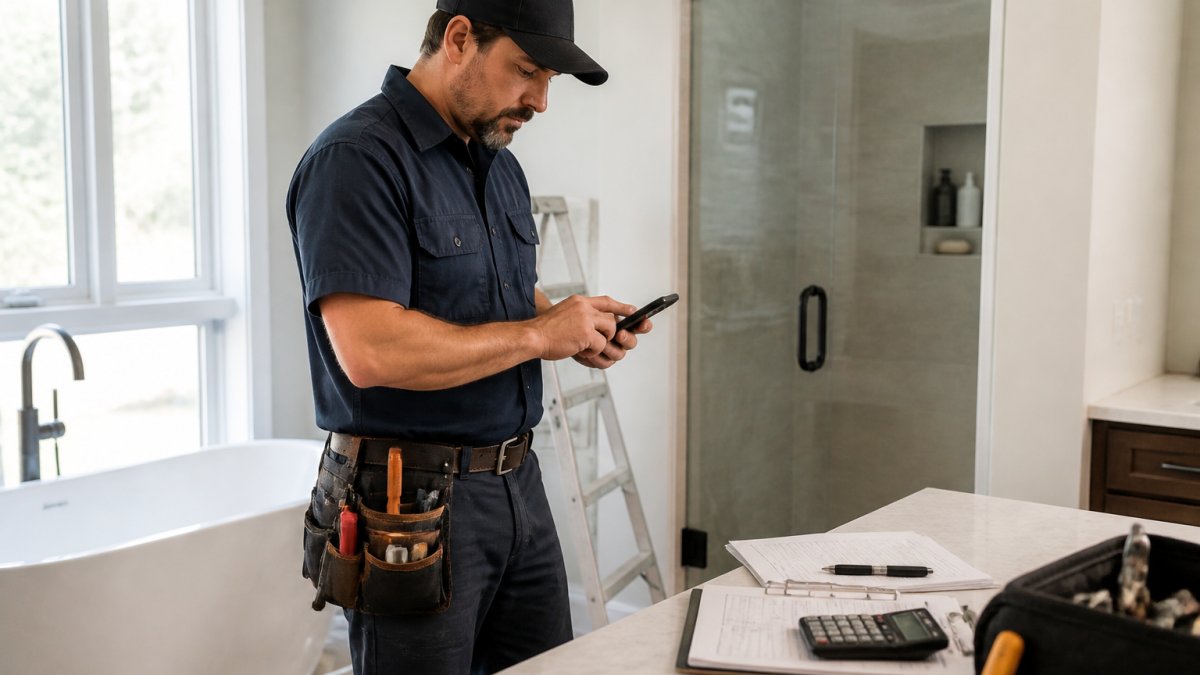
The workflow should be simple. Tech arrives at the job. Opens the app. Starts the timer. Logs materials as they're used. Stops the timer when done. The app calculates labor cost based on hours logged. It calculates material cost based on items consumed.
If the workflow requires the tech to log into a desktop system later, enter data manually, and wait for the office manager to reconcile everything, the tech won't use it. They'll go back to pen and paper.
Training matters. Your team needs to understand why they're logging this data. If they see job costing as busy work, they'll skip it. If they see it as the tool that helps them understand which jobs make money, they'll use it.
The implementation timeline is typically two to four weeks for a small shop. Week one: set up job costing categories and labor rates. Week two: run parallel tracking on a few jobs to validate the data. Week three: train the team and go live.
Conclusion
Simple job costing software for plumbers solves one core problem: the gap between what you estimated and what the job actually cost. That gap is where profit disappears. Close it, and you improve margins without raising prices. Most plumbers know they should track costs. The barrier is that legacy software treats job costing as a feature, not the foundation. MEPflow was built by trade professionals specifically to make job costing the core workflow, not an afterthought. The platform lets you estimate, track labor and materials, and invoice from the truck. You see actual costs versus estimates in real time, which means you improve your bids with real data, not guesses. Start free with MEPflow and see how job costing reconciliation changes your profitability.
| Feature | Why It Matters | How It Works |
|---|---|---|
| Mobile-first estimating | Quotes generated on-site close faster | Tech creates estimate in app before leaving |
| Labor time tracking | Actual hours logged reveal estimating gaps | Timer starts and stops with each task |
| Material consumption logging | Real material costs replace guesses | Tech scans or logs items as they're used |
| Estimate-to-actual reconciliation | Data improves future bids | Software compares estimated vs. actual after job closes |
| On-site invoicing | Payment captured before tech leaves | Invoice sent from truck before customer is forgotten |
Frequently Asked Questions
What is job costing software for plumbers?
Job costing software tracks all costs associated with a specific plumbing job, labor hours, materials used, overhead, and compares them against the estimate. This reveals actual profitability per job and helps plumbers identify which types of work generate the strongest margins. The software typically integrates estimating, time tracking, materials tracking, and invoicing into one platform so you can see the full picture from quote to completion.
How does plumbing labor and material cost tracking improve accuracy?
Real-time tracking captures labor hours and material consumption as they happen in the field, eliminating memory gaps and manual data entry errors. When technicians log actual costs immediately on a mobile device, the software can reconcile those actuals against the estimate, showing variances in real time. This accuracy reveals true job profitability, prevents cost overruns from going unnoticed, and gives you data to refine future estimates.
Can a plumbing job costing template help a small shop get started?
Yes. A well-designed template standardizes how you categorize labor costs (service calls, repairs, installations), material costs (fixtures, pipe, fittings, supplies), and overhead allocations. Starting with a template reduces setup time and ensures consistency across jobs. Most modern job costing software includes customizable templates that you can tailor to your specific service offerings and cost structure, making adoption faster for small teams.
Why is invoicing before leaving the job site valuable?
Invoicing on-site accelerates cash flow, you get paid the same day rather than waiting days or weeks for a mailed or emailed invoice. It also reduces payment disputes because the customer sees itemized labor and materials while the work is fresh in their mind. For small plumbing shops managing cash flow tightly, same-day payment can be the difference between meeting payroll and carrying debt.
Where to next
- See what MEPflow doesScheduling, estimates, dispatch, invoicing and job costing in one app.
- Create your company accountSet your shop up in a few minutes. No card to start.
- How to Reduce Field Service Scheduling TimeMore from the MEPflow blog
- Cut No Shows 25%: Text Appointment Reminders for Service ShopsMore from the MEPflow blog